

You must install a fire exit sign in every room that has an exit or exit access. Both OSHA and NFPA 101 mandate this requirement. These signs protect occupants during emergencies and keep your building legally compliant. Ignoring them leads to serious penalties.
This guide explains the exact design standards, placement rules, size requirements, and illumination needs for fire exit signs. You will learn how to meet OSHA 1910.37 and NFPA 101 Life Safety Code. The focus stays strictly on regulatory specifications. You will not find historical background or general fire safety tips here.
Understanding these rules helps you avoid costly violations. It also ensures everyone inside your building can find a safe way out when seconds matter most.
Install fire exit signs above every exit door and along exit routes. Ensure no point on the path is more than 100 feet from a visible sign.
Use letters at least 6 inches tall with a stroke width of 0.75 inches. The sign must be visible from 100 feet away.
Illuminate signs to at least 5 foot-candles. Provide battery backup for 90 minutes during power outages.
Place directional signs with arrows at intersections and turns. This guides people when the exit is not directly visible.
Test signs monthly for 30 seconds and annually for 90 minutes. Keep records for at least three years.
You must choose the right color for your fire exit sign. OSHA does not mandate a single color. The standard requires the sign to be "distinctive in color" against its background. Both red and green remain acceptable under federal rules. However, NFPA 101 also avoids a strict color mandate. Local authorities having jurisdiction (AHJ) may impose their own preferences. You should always check with your local fire marshal before purchasing.
Green stands as the international standard for safety. Many facilities choose green because it signals "safe" or "proceed" in global contexts. Red also works, but you must ensure it contrasts sharply with the wall behind it. One practical example shows a retail store forced to change red signs to green. The red signs blended into the red wall paint, making them insufficiently distinctive. The fire marshal required the change to maintain visibility.
The word "EXIT" remains the mandatory legend throughout North America. OSHA requires this exact word on every sign. The running man pictogram appears commonly, but it is not mandatory. You may add it for clarity, especially in multilingual workplaces. OSHA accepts ISO 7010-style pictograms when they effectively communicate the hazard. Many international facilities post both text and symbol versions side by side.
Aspect | OSHA Requirement | NFPA 101 Requirement |
|---|---|---|
Color | No single mandated color; sign must be 'distinctive in color' | No specific color mandate; local AHJ may dictate preference |
Symbols | Requires 'EXIT' lettering; directional arrows required when exit path is not directly visible | Requires directional arrows when path turns or exit is not visible |
Illumination | Signs must be illuminated to at least 5 foot-candles | Signs must remain illuminated at all times; internally lit signs must comply with ANSI/UL 924 |
Lettering | Letters at least 6 inches tall with 3/4-inch stroke width | Lettering must be large and easy to read; externally lit signs need sufficient contrast |
Under OSHA standard 1910.37, every exit must be clearly visible and marked by a sign reading 'Exit.' The letters have to be at least six inches tall with a three-quarter-inch stroke width—meaning the actual thickness of each letter. Signs must be illuminated to at least five foot-candles (that's a measure of light intensity) by a reliable source, and they must be distinctive in color.
You must ensure your sign passes the legibility test from a distance. The six-inch letter height applies to the lettering itself, not the mounting height. The three-quarter-inch stroke width means each letter's lines must be thick enough to read quickly. Thin fonts fail this requirement. You should select a bold, sans-serif typeface for maximum clarity.
Contrast determines whether occupants can spot the sign during an emergency. The sign face must stand out from its mounting surface. A green sign on a green wall fails this test. A red sign on a red wall also fails. You need a clear difference between the sign background and the letter color. Customizable colors and languages are available for fire exit signs. The default green remains the recommended choice for compliance. Always verify the final contrast against the actual wall color before installation.

You must mount every fire exit sign directly above the exit door it identifies. OSHA does not specify a universal mounting height; only the letter dimensions are regulated. However, NFPA 101 allows mounting above the door or on the ceiling, and the International Building Code (IBC) sets a minimum of 80 inches from the finished floor. The sign should be placed so it is within your natural line of sight. You should not place it too high, because occupants may miss it during a rushed evacuation. The sign must remain visible even when the door stands open. A door propped open can hide a sign mounted too close to the frame. Leave enough clearance so the sign stays readable from any approach angle.
Spacing rules apply along the entire exit route, not just at the final door. The standard requires that no point along an evacuation path sits more than 100 feet from the nearest visible sign. This distance creates a continuous chain of visual cues. You should walk your corridors and measure the sightlines yourself. A long hallway may need intermediate signs even if no door exists there. The 100-foot rule applies to the viewing distance, not the walking distance. Obstructions like columns or storage racks can break a sightline. You must account for these obstacles when you plan sign placement.
Requirement Category | Specific Rule |
|---|---|
Illumination | Signs must be illuminated at all times via electrical, battery backup, or photoluminescent materials. |
Letter Size | The word EXIT must be at least 6 inches high with stroke width of at least 0.75 inches. |
Visibility Distance | Signs must be visible from at least 100 feet under normal and emergency lighting. |
Placement & Spacing | Signs above every exit door and at decision points; no point along an evacuation path more than 100 feet from a visible sign. |
Directional Indicators | Required where exit is not immediately visible; must follow same illumination and visibility rules. |
You must also ensure nothing blocks or obscures your signs. OSHA prohibits any decoration, equipment, or storage that hides an exit sign. A sign covered by a hanging plant or a stacked pallet fails inspection immediately. Check your signs regularly to confirm they remain unobstructed. This simple habit prevents most compliance failures.
Directional signs become mandatory when the exit path turns or the exit is not directly visible. You cannot assume occupants will guess the correct direction. The code requires clear visual guidance at every decision point. A decision point means any location where the path splits or changes direction. Without an arrow, occupants may choose the wrong route and waste precious seconds.
Directional signs with arrows are required where the exit is not immediately visible. Additionally, no point along an evacuation path should be more than 100 feet from a visible exit sign, which often necessitates directional signs in long corridors and at corridor junctions.
Different intersection types demand different sign configurations. You must match your signage to the actual geometry of your building.
Intersection Type | Required Signage |
|---|---|
L-turn (90° corner) | One directional sign, positioned so the arrow is visible before or at the corner |
T-intersection (traffic from stem) | Two directional signs: one arrow left, one arrow right (unless one-way path) |
4-way intersection | Up to three directional signs, depending on approach legs and shortest exit route; if two exits are equidistant, mark both directions |
You should place arrowed signs so occupants see them before they reach the decision point. This advance warning gives people time to process the direction and adjust their movement. Some fire exit sign models offer removable directional indicators. You can snap arrows on or off to match your building's actual egress paths. This flexibility simplifies compliance when you reconfigure a space. You simply adjust the arrows instead of ordering new signs. The removable design also helps during inspections, because you can demonstrate the correct path configuration quickly.
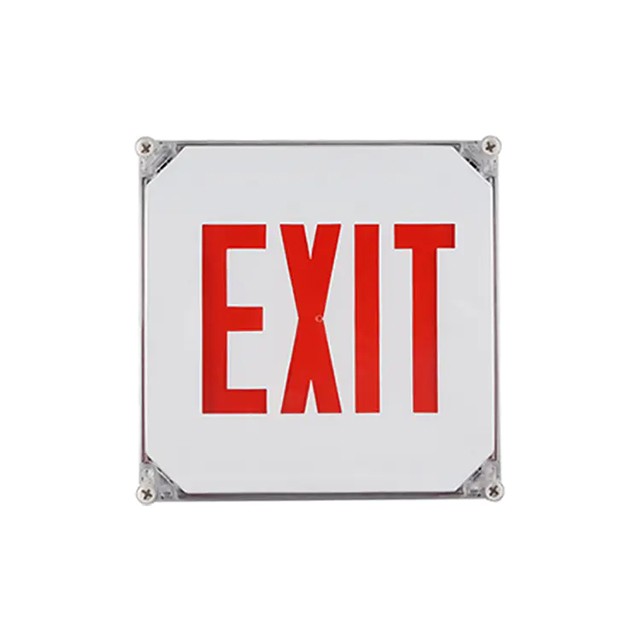
You must install a fire exit sign that meets precise size standards. Under OSHA 1910.37, the letters on your sign must be at least 6 inches tall. The stroke width – the thickness of each letter line – must be at least 0.75 inches. These dimensions ensure occupants can read the word “EXIT” quickly from a distance. The 6-inch height applies to the lettering itself, not the sign panel.
The viewing distance requirement follows directly from the letter size. The code mandates that no point along an evacuation path be more than 100 feet from the nearest visible sign. This means you must place signs so occupants never have to look farther than 100 feet to see one. You should measure the actual sightlines in your corridors, not just the walking distance. Obstructions like columns, furniture, or open doors can block the view. If a sign is hidden behind a corner, you need an additional directional sign at the decision point.
Illumination is another critical factor for visibility. Your sign must be illuminated by a reliable light source. OSHA requires at least 5 foot-candles (54 lux) of light on the sign face. This level ensures the sign stands out even in a dark corridor. You must verify that the light source provides at least 5 foot-candles on the sign face. The table below summarizes the key minimum specifications.
Requirement | Minimum Specification |
|---|---|
Letter height for “EXIT” | 6 inches |
Stroke width | 0.75 inches |
Visibility distance | 100 feet (under normal and emergency lighting) |
Illumination level on sign face | 5 foot-candles (54 lux) |
Your fire exit sign must remain visible during a power failure. The code requires a reliable backup power source. NFPA 101 and NFPA 70 mandate that the emergency battery backup provide at least 90 minutes of illumination during an annual full-duration test. This means your sign must stay lit for 90 minutes after the main power goes out. You must test this function regularly to confirm the battery holds its charge.
NFPA 101 and NFPA 70 require that exit sign emergency battery backup provide a minimum of 90 minutes of illumination during an annual full-duration test.
LED and photoluminescent fire exit signs are available that meet this requirement. LED models often include a built-in Ni-Cd or Ni-MH battery that ensures at least 90 minutes of emergency power. Photoluminescent signs absorb ambient light and glow for hours without any electricity. Both options provide visibility even in smoky or dark conditions.
All UL 924 listed signs meet the strictest illumination and performance standards. UL 924 covers internal illumination, battery backup duration, and sign durability. When you buy a UL 924 listed sign, you know it will perform during an emergency. You should always check the listing label before installation. A non-listed sign may fail an inspection and put occupants at risk.
You must also consider the mounting location. The battery backup only works if the sign is installed correctly. Follow the manufacturer’s instructions for wiring and placement. Test the sign after installation to ensure the emergency light turns on when you cut the main power. Document the test results for your records. Regular monthly checks and annual full-duration tests keep your system compliant. Replace any battery that fails to meet the 90-minute requirement.
OSHA and NFPA 101 work together as the primary regulatory frameworks for fire exit sign compliance. OSHA sets the federal baseline for workplaces. It requires every exit to remain clearly visible with a sign reading "EXIT." The letters must stand at least 6 inches tall with a 3/4-inch stroke width. You must illuminate the sign face to at least 5 foot-candles. NFPA 101 goes further as the standard most state and local building codes adopt. It governs additional details such as sign spacing and mandates a 90-minute minimum battery backup duration.
Statutory Aspect | OSHA (29 CFR 1910.37) | NFPA 101 (Life Safety Code) |
|---|---|---|
Spacing | No point along an evacuation path more than 100 feet from a visible sign; signs must be visible from at least 100 feet | 100-foot benchmark derived from clear visibility combined with UL 924 rated viewing distance |
Mounting Height | No universal mounting height specified; only letter dimensions are regulated | Allows door, above frame, or ceiling mounting; IBC sets 80-inch minimum from finished floor |
Battery Backup Duration | Requires illumination during emergencies but does not specify a duration by name | Mandates 90-minute minimum backup for emergency lighting and exit signs |
Fire exit sign products that are UL 924 listed meet the strictest illumination and performance standards. You should always verify the UL 924 label before installation. A sign without this listing fails inspection regardless of marketing claims.
You must test your signs regularly to maintain compliance. The testing schedule follows a clear pattern.
Test Type | Frequency | Duration |
|---|---|---|
Monthly functional check | Monthly | 30 seconds (quick test of illumination and battery backup) |
Annual battery endurance test | Annually | 90 minutes (full discharge test to verify battery can sustain illumination) |
You can verify compliance through several practical steps:
Obtain a UL 924 cut sheet or label for the exit sign.
Provide evidence of face illuminance, ensuring at least 5 foot-candles.
Confirm that locations and directional chevrons are marked on building plans.
Perform a quick "lights-out" check to verify legibility at the rated distance.
For photoluminescent signs, you should wipe the sign face with a damp cloth during routine rounds. Dust and film reduce charging and legibility. Maintain area lighting by promptly replacing failed lamps. Treat this as part of life-safety, not routine maintenance. Conduct periodic dark checks to confirm legibility persists past 90 minutes. Keep records of light levels and inspection dates. Update these records whenever fixtures or controls change. Replace signs only if physically degraded or persistently dim despite adequate light. There is no hard expiration date for these signs.
Fire exit sign compliance demands attention to design, placement, size, and illumination. You must follow these standards in every room with an exit. Regular inspections protect occupants and prevent costly penalties.
Common inspection failures include unlit signs, damaged units, and missing components. You can avoid these issues with a simple monthly check. Walk your building and look for any non-compliant signs. Verify each unit activates when power is lost. Schedule an annual 90-minute full-discharge test. Document every result for at least three years.
Non-compliance can lead to severe penalties. A professional audit ensures your building meets all requirements. Take action today to safeguard lives and maintain compliance.
Yes, OSHA and NFPA 101 accept both colors. The sign must contrast sharply with its mounting surface. Check with your local fire marshal first, since some jurisdictions prefer one color. Green remains the international safety standard and the recommended default.
OSHA does not specify a mounting height; the sign should be placed so it is clearly visible. NFPA 101 allows mounting above the door or on the ceiling, and the International Building Code (IBC) sets a minimum of 80 inches from the finished floor.
Perform a 30-second functional check monthly. Run a full 90-minute endurance test annually. This schedule follows NFPA 101 requirements. Document every test result for at least three years. Replace any battery that fails to sustain illumination for the full duration.
OSHA prohibits anything that obscures an exit sign. A blocked or unlit sign fails inspection immediately. Walk your building monthly to check for obstructions. Verify each unit activates when power is lost. Fix any issues before they become violations.

Phone: 0086-13566557272
Whatsapp: +86-13566557272
ADD: No.546 Qiye Road, Zhouxiang Town, Cixi, Zhejiang, China
ADD: Within Dinh Vu - Cat Hai Economic Zone, Dong Hai 2 Ward, Hai An District, Hai Phong City, Viet Nam
Customer Message


 Dual Head Emergency Light
 LED Emergency Light Remote Head
 Twin Spot Emergency Light
 Rechargeable LED Emergency Light
 Emergency Downlight
 Fire Exit Sign
 Running Man Exit Sign
 SALIDA Exit Signs
 SAÍDA Exit Signs
 Recessed Exit Sign
 UL Listed Exit Light
 Customized EXIT SIGN
 Power & Lighting Exit Sign
 Mounting & Housing Exit Sign
 Self Test Exit Sign
  Directional exit sign
 Custom Legends exit sign
 Custom Acrylic Signs
 LED Emergency Inverter
 Emergency Ballast
 Emergency Battery